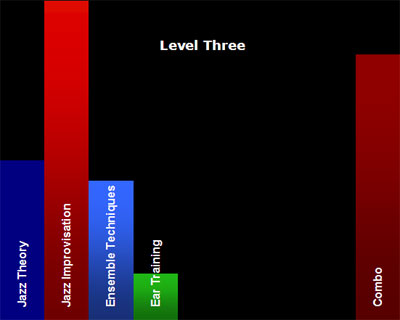
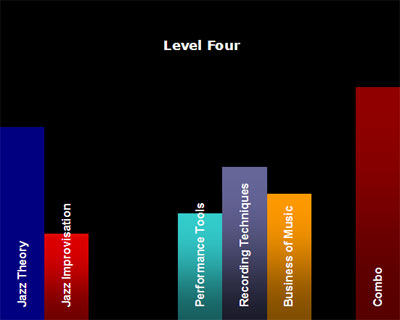
The Jazz Arts Studio curriculum is presented in six levels, each spanning 23 weeks of classes and combos over the course of approximately six months. All classes and combos are conducted Sunday through Thursday evenings, year-round, with scheduled one or two-week breaks throughout.
Throughout all levels, students are asked not only to learn the material, but also to be able to identify it aurally and integrate it into their playing. Essentially - know it, hear it, play it. Towards this goal, three forms of evaluation are used: written tests, ear training tests and jazz boards.
Graphs are provided above each level to illustrate the approximate amount of class time which is appropriated to each area of instruction. They also provide comparisons from level to level as the program progresses.
The following are integrated throughout the appropriate levels.
Listening Examples
Secondary Jazz Piano
Improvisational Vocabulary
Written Solos
Repertoire Development
Transcriptions and Analysis
Jazz History
Project Participation
Performance Master Classes
Access to a computer and the Internet
Cell phone - text capable
Reasonable technical proficiency on your primary instrument
Immediate recall of key signatures and the circle of fifths
Ability to read both clefs common to the Grand Staff
Ability to read traditional music notation
(Tablature is not an acceptable substitute)
If needed, tutoring is available to help you prepare for Level One
Level One
Jazz Defined: Primary Characteristics
Approach to Jazz Studies: Areas of Study
Theory versus the Ear in Jazz
Intro to Professional Performance Standards
Practice Techniques
Universals of Instrumental Technique
Principal Eras of Western Music
Survey of Jazz History & Artists
Stylistic Evolution
Important Performers, Composers & Arrangers
Intro to the Jazz Repertoire
Jazz Compositions
The Great American Songbook
Other Sources from which Jazz Standards Derive
Form & Analysis
Study of Meter
Duple, Triple & Odd Meters
Simple & Compound Meters
Mixed Meters
Metric Modulation
Hemiola
Musical Terms & Symbols
Scales: Major; Natural, Harmonic & Melodic Minor; Harmonic Major
Intro to Parent Scales & Mode Relationships
Historical Significance of Modes
Chord Symbols Involving Upper Extensions
Classical versus Jazz Nomenclature
Slash Chords/Polychords
Hybrid Chords
Correlating Modes of the Melodic Minor Scale
Correlating Modes of the Harmonic Minor & Harmonic Major Scale
Modal Interchange
Correlating Synthetic Scales: Symmetric & Non-Symmetric
Octatonic Scale, Augmented Scale, Whole-Tone Scale, Chromatic Scale
Major, Minor & Altered Pentatonic Scales
Major & Minor Bebop Scales
Major & Minor Blues Scales
Double Harmonic Scales
Double Harmonic Minor Scales
Polychord/Scale Relationships
Morph Exercise: Application of Modes through Progressions
Intro to Improvisational Concepts
The Creative Process
Composing in Real Time
Real-Time Editing
Solo Architecture
Creative Correlatives
Melodic Phrasing
Harmonic Phrasing
Playing the Changes
Harmonic Generalization
Derivative Playing
Angular versus Linear Improvisation
Melodic Patterns: Use & Practice
Common Jazz Styles
Swing, Bossa, Samba, Ballad, Jazz Waltz, Jazz/Rock, etc.
Repertoire: Insight & Development
Style & Interpretation
Jazz Rhythms
Syncopation
Articulation
Dynamics
Reading Jazz Rhythms
Principles of Rhythmic Dictation
Traditional & Jazz Rhythms
Intro to Comping: Rhythm
Interactive & Supportive
Traditional Harmonic Analysis
Roman Numeral System
Diatonic & Chromatic Harmony
Cadential Progressions
Tonicization & Modulation
Secondary Dominant Chords
Analysis of Classical Literature
Jazz Harmonic Analysis
Dispensing Diatonic Expectations
Mehegan System
Hybrid Harmonic Analysis
Modulations
Direct
Prepared
Pivot Chords (Dual Function)
Transitional (i.e. “Back-Door”)
Harmonic Rhythm
Definition and Use
Double Time Feel & Double Time
Harmonic Anticipation
Prerequisites for Level Four
Satisfactory completion of Level Three
Level Four
Live Performance Skills
Performance Anxiety
Planning & Preparation
General "On-the-Gig" Skills
Stage Presence
Business of Music
Business Terms
Communication Skills
Negotiation Techniques
Music Performance Contracts
Marketing & Promotion
The Media as a Resource
Fair Market Value: Determining Performance Fees
Performance Rights
Copyright Protection
Ethical Standards & Practices
Financial Skills for the Working Musician
Advanced Musical Concepts
Imagery
Tendencies
Perspective Listening
Performing with Musicians of Varied Backgrounds & Skills
Specialized Performance Skills
Conducting Skills
Following a Conductor
Playing in a Pit Orchestra
Orchestral Engagements
Recording Session Work
Prerequisites for Level Six
Satisfactory completion of Level Five
Level Six
Study of Commercial & Studio Music
Jazz Pedagogy
Artistic & Professional Performance Studies
Private Study
While classes and combos offer plenty of opportunity for individualized and focused attention, private lessons with Eric Zadan are also available.
Ongoing lessons are available exclusively to qualified students enrolled in the program. Non-enrolled students are instructed on a lesson-by-lesson basis at the single lesson rate.
Private tutorial lessons are available with an assistant on an as-needed basis.
Additionally, private lessons with an associate professional are available for Jazz Arts Studio students at an appropriate level. A recommendation from Eric Zadan is required.
Certificates/Diplomas
Professional Certificate
Satisfactory completion
Levels One thru Four
(333.50 hours)
Artist Diploma
Satisfactory completion
Levels Five & Six
(253.00 hours)